Why smart people make bad money decisions

Why smart people make bad money decisions?

Most financial mistakes are not made by uninformed people—they're made by smart ones. The reason isn't knowledge, it's cognitive bias. Here are the six that show up most, and what to do about each.

Read on LinkedIn →


Questions you should ask your financial advisor

Questions you should ask your financial advisor

Your advisor may recommend a product because it pays them more. Before you say yes to any recommendation, ask these 8 questions—the answers reveal whether they work for you or for their margin.

Read on LinkedIn →
Re-Align instead of Retire

Re-Align instead of Retire

Most of us never sat down and designed our working life—we responded to it. Somewhere in that journey the real question quietly gets missed: not what's the next step, but what are we actually building toward?

Read on LinkedIn →
Why this generation earns more but feels poorer

Why This Generation Earns More — But Feels Poorer

India has never produced so many young professionals earning ₹10 lakh-plus at the start of their careers. Yet many feel stretched, anxious, and hesitant about life's biggest decisions. Here's why.

Read on LinkedIn →
The 2 am Slack message

The 2 a.m. Slack Message

We spend years planning for retirement. But how many of us plan for life before retirement? Real freedom is the ability to slow down, take a break, or change direction before life forces you to.

Read on LinkedIn →
Mutual Funds Sahi Hai

Mutual Funds Sahi Hai

Mutual Funds Sahi Hai. Absolutely! But the campaign missed one important sentence. If you're investing through SIPs—or planning to start—this might change how you look at mutual funds.

Read on LinkedIn →
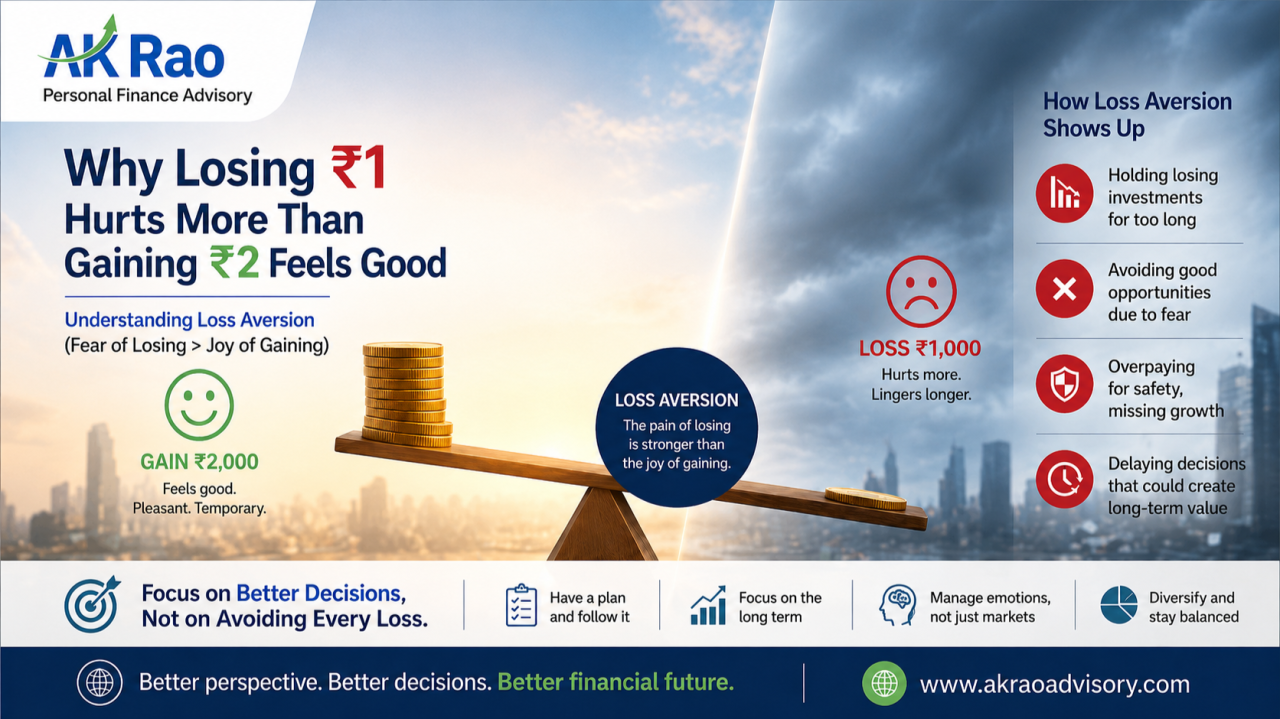
Why losing one rupee hurts more than gaining two

Why Losing ₹1 Hurts More Than Gaining ₹2

We don't make financial decisions with spreadsheets. We make them with feelings—then find numbers to justify them. Understanding loss aversion is the first step to better decisions.

Read on LinkedIn →
The Sandwich Generation

The Sandwich Generation

For professionals between 40 and 55—raising children and caring for ageing parents at once—the margin for error is smaller than most realise. Here are the six most critical mistakes, and how to avoid each.

Read on LinkedIn →

Why most retirement estimates are wrong

Why Most Retirement Estimates Are Wrong

Most retirement calculators give you a number. What they won't tell you is whether that number is right—or whether the assumptions underneath it are quietly working against you.

Read on LinkedIn →
Coming Home — a financial guide for returning NRIs

Coming Home

A friend called me from abroad. He had made up his mind—he was coming home. Then the most important question came up: “What do I do with my money?” A financial guide for returning NRIs.

Read on LinkedIn →
Why we keep throwing good money after bad

Why We Keep Throwing Good Money After Bad

We find it painful to admit we were wrong. In finance, that pain keeps us tied to sinking ships, waiting for a recovery that may never come. Here's why we struggle to walk away—and how to change course.

Read on LinkedIn →
What a financial plan should actually contain

What a Financial Plan Should Actually Contain

Have you ever stepped back and asked: “Do I actually have a financial plan, or do I just own a lot of financial products?” That simple question inspired this article.

Read on LinkedIn →
Three clients, three net worths, one mistake

Three Clients, Three Net Worths, One Mistake

Financial planning is not about buying more products—it's about seeing the complete picture. Three anonymised client situations reveal a common mistake even successful professionals make.

Read on LinkedIn →
Do we still need a financial advisor in the age of AI

Do We Still Need a Financial Advisor in the Age of AI?

“Will ChatGPT replace financial advisors?” It will replace advisors who sell information. It will elevate advisors who deliver judgment, perspective and trust. Here's why.

Read on LinkedIn →
Advice isn't free

Advice Isn't Free

The most expensive financial advice you receive may be the advice you never paid for. Because someone is always paying for that advice—make sure it's working for you.

Read on LinkedIn →
High income, low investable net worth

High Income, Low Investable Net Worth

I often meet people who earn exceptionally well but feel they're not getting ahead. It isn't that they don't earn enough—it's that somewhere along the way, lifestyle grew faster than wealth.

Read on LinkedIn →

FOMO — the most expensive emotion in investing

FOMO

Your biggest investing mistake probably won't come from a bad investment—it will come from a great story. A cousin's 5x crypto, a hot IPO, a WhatsApp group. Here's how FOMO quietly takes control.

Read on LinkedIn →

Your wedding creates a new entity — HUF

Your Wedding Creates a New Entity: HUF

Most salaried professionals think they've exhausted every tax-saving option. What if your wedding created a second taxpayer in your family—one that most people never use? Meet the HUF.

Read on LinkedIn →

Will your money outlast you

Will Your Money Outlast You?

We often ask, “Will I have enough to retire?” A better question: “Will my plan still work if life doesn't go as planned?” That's what Financial Freedom Stress Testing is all about.

Read on LinkedIn →
Careers have changed, shouldn't your financial planning

Careers Have Changed. Shouldn't Your Financial Planning?

Your biggest career risk in 2026 isn't losing your job. It's believing your current career will carry you all the way to retirement. Plan not just for today—plan for every reinvention.

Read on LinkedIn →
A fully funded education, an unfunded retirement

A Fully Funded Education. An Unfunded Retirement.

Our children's education is one of the most important goals we plan for. But how do we make sure it doesn't come at the expense of another crucial goal—our own retirement?

Read on LinkedIn →
Your SIP is fixed, your life isn't

Your SIP Is Fixed. Your Life Isn't.

A Systematic Investment Plan is designed to be predictable—life is designed to be anything but. There are years you can invest more, and years you need to breathe. Should your plan move with your life?

Read on LinkedIn →
Her choice, your plan

Her Choice, Your Plan

Who earns the money is easy to see. Income is easy to measure—contribution is not. A strong financial plan includes both partners, in every sense.

Read on LinkedIn →