A sample financial plan
A section-by-section look at a complete financial plan. Select a section on the left to view it — each shows what that part covers and how it helps you decide.
Illustrative example · figures are hypotheticalYour Financial Plan — An Overview
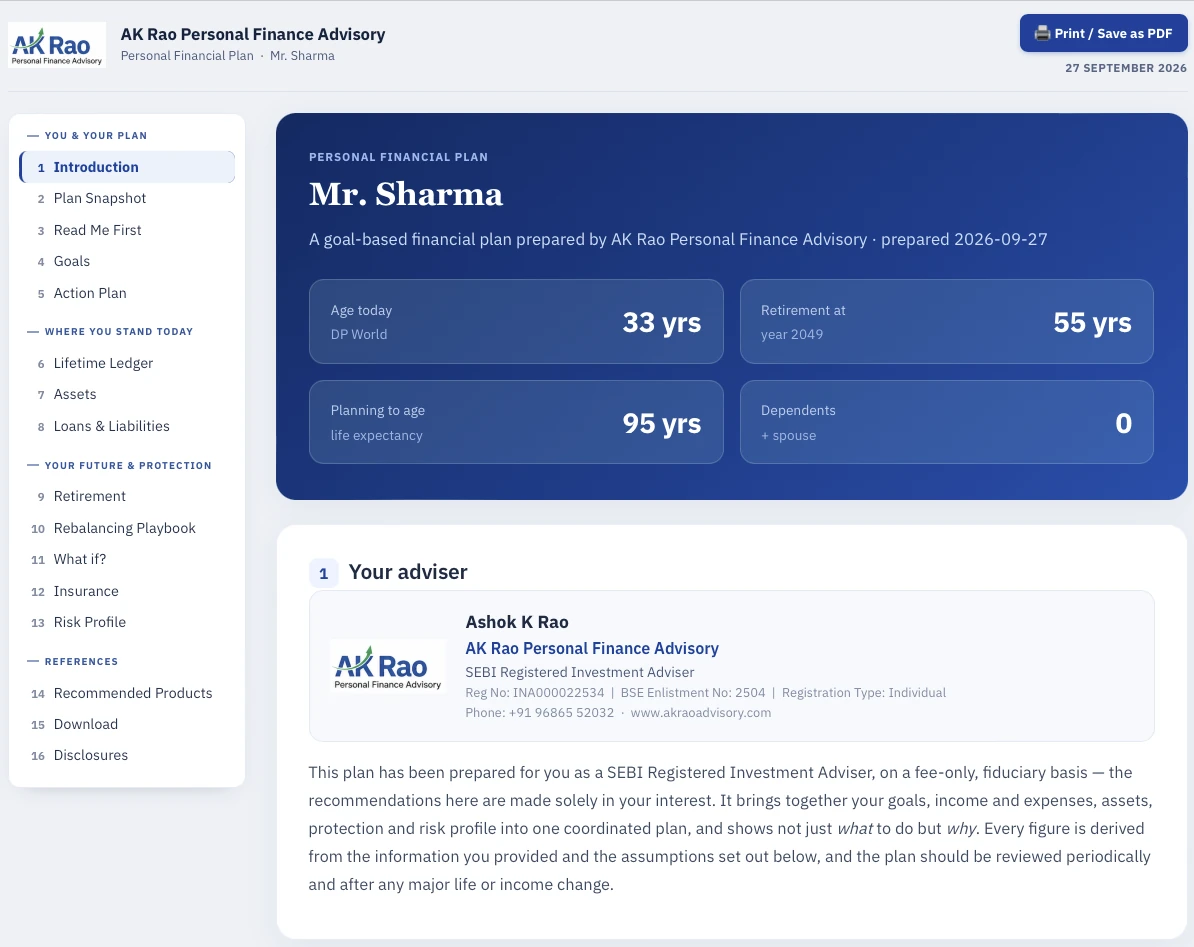
The plan brings together your goals, your finances, your protection and your investments into a single, coordinated document. It sets out where you stand today, where you would like to reach, and the steps that connect the two — together with the reasoning behind each recommendation. Every plan is prepared individually: the goals, the assumptions and each recommendation are shaped around your circumstances, and reviewed with you across several conversations before the plan is finalised.
The plan is prepared for you as an individual, on a fee-only basis. It opens with your profile and the assumptions used, then works in turn through your current position, your goals, the roadmap, your investments, retirement, risk, and implementation.
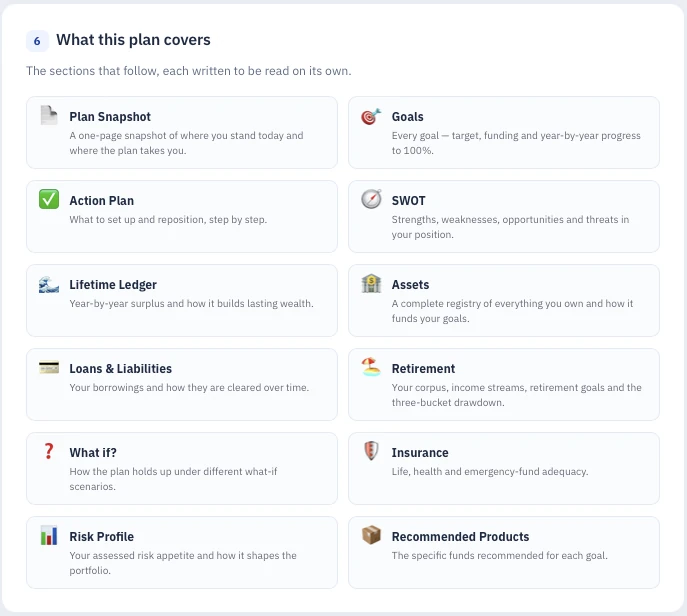
A single view of every section the plan contains — from your snapshot and goals through to retirement, risk and implementation — each written to be read on its own.
Your Current Financial Position
Before any recommendation is made, the plan documents your starting point in full — what you earn and spend, what you own and owe, how you are protected, and how you are currently invested.
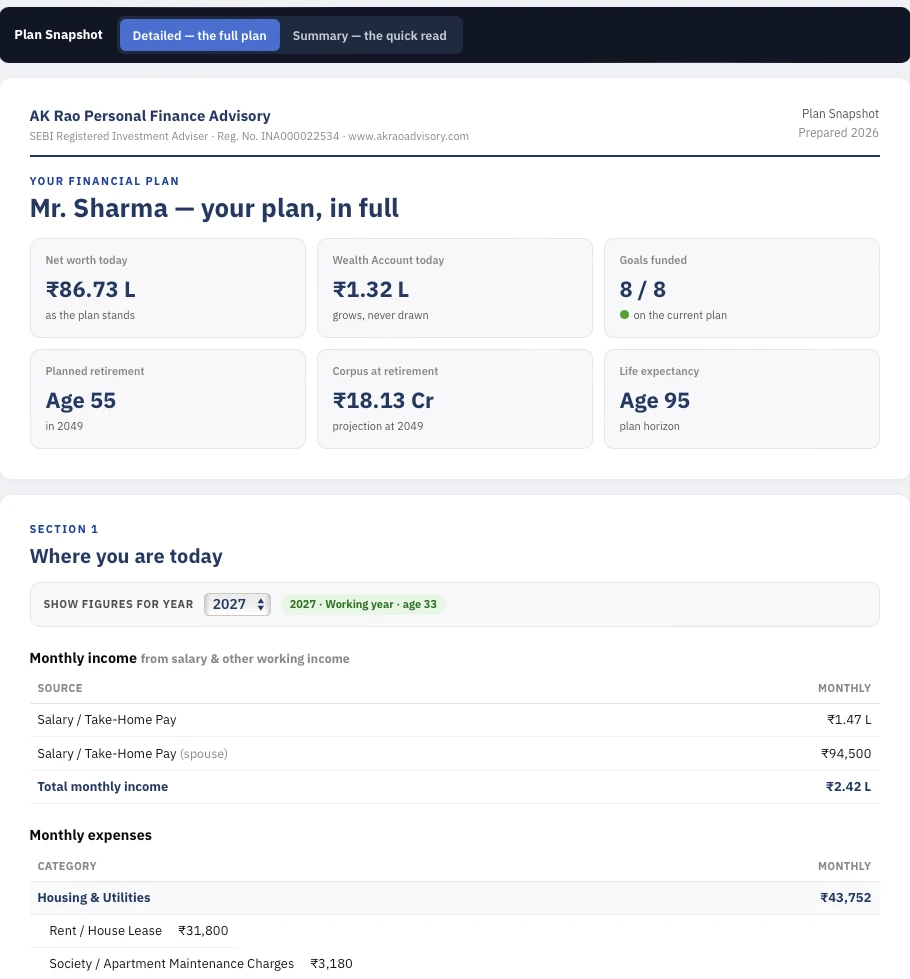
What you earn and what you spend each month, captured in full and category by category — the foundation on which the rest of the plan is built, shown alongside a snapshot of where the plan stands today.
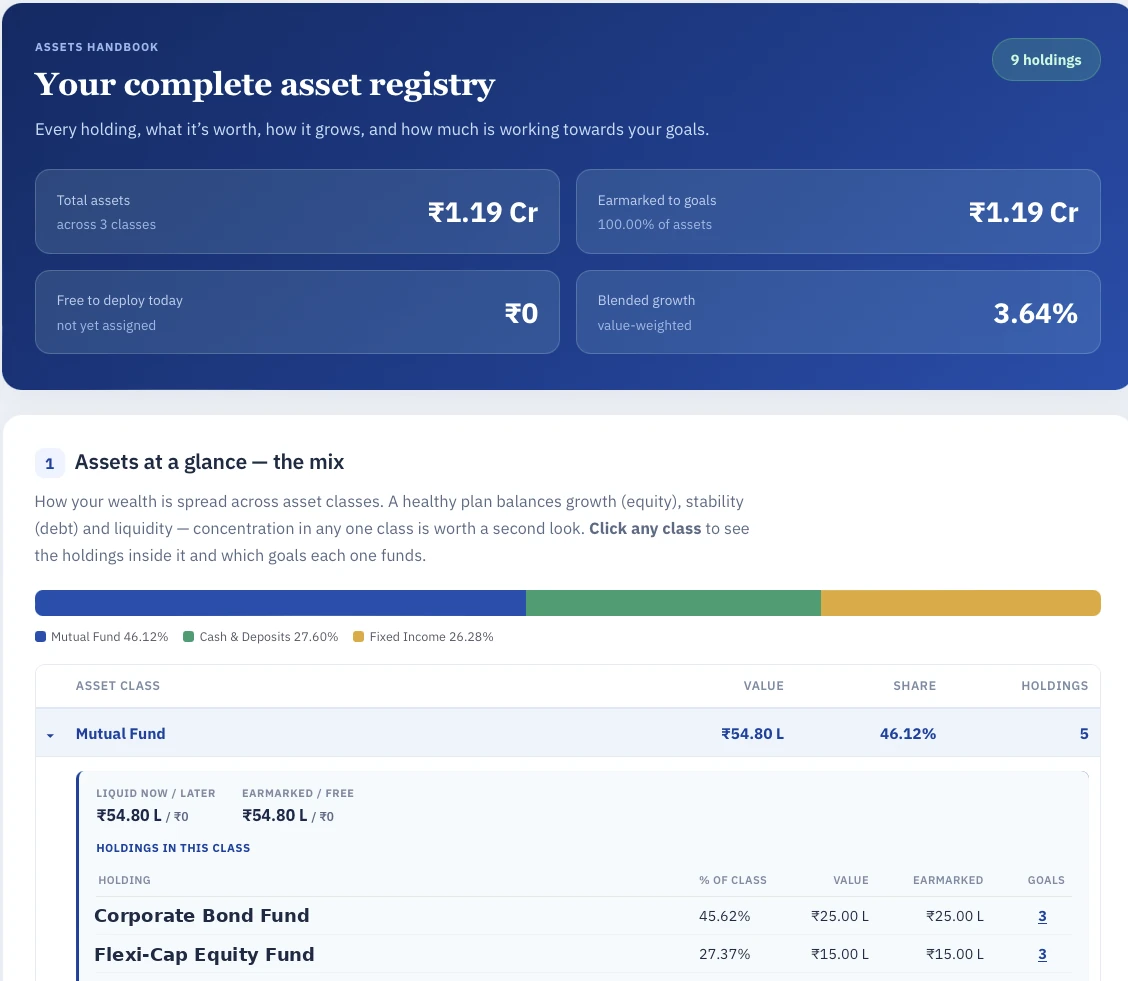
A complete record of what you hold today, grouped by asset class, with its current value, how it is expected to grow, and the goals it is presently allocated toward.
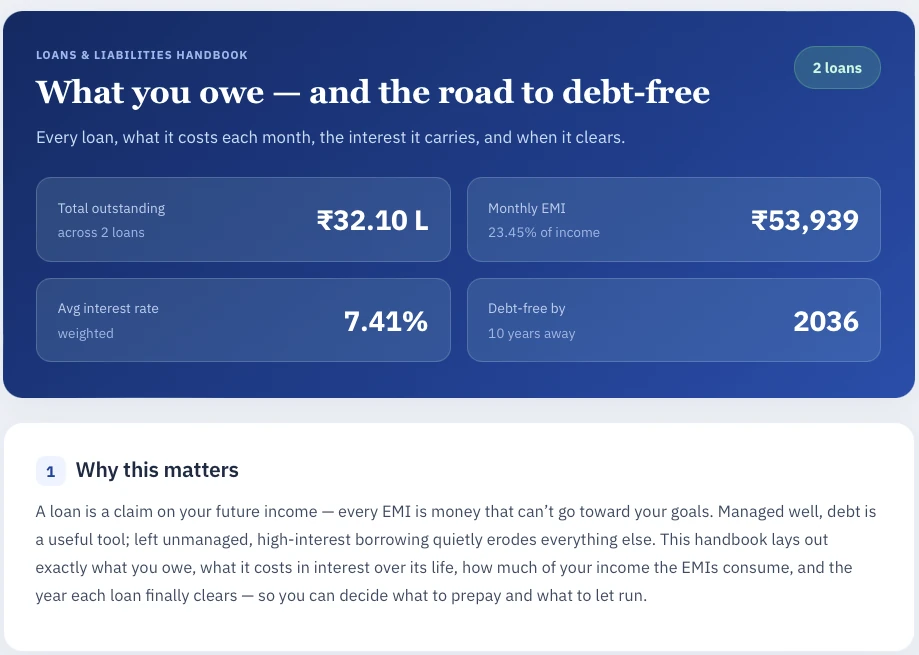
Each loan you carry, its monthly instalment, the interest it attracts, and the year in which it is scheduled to be repaid in full — with the road to debt-free and the interest still to pay laid out year by year.
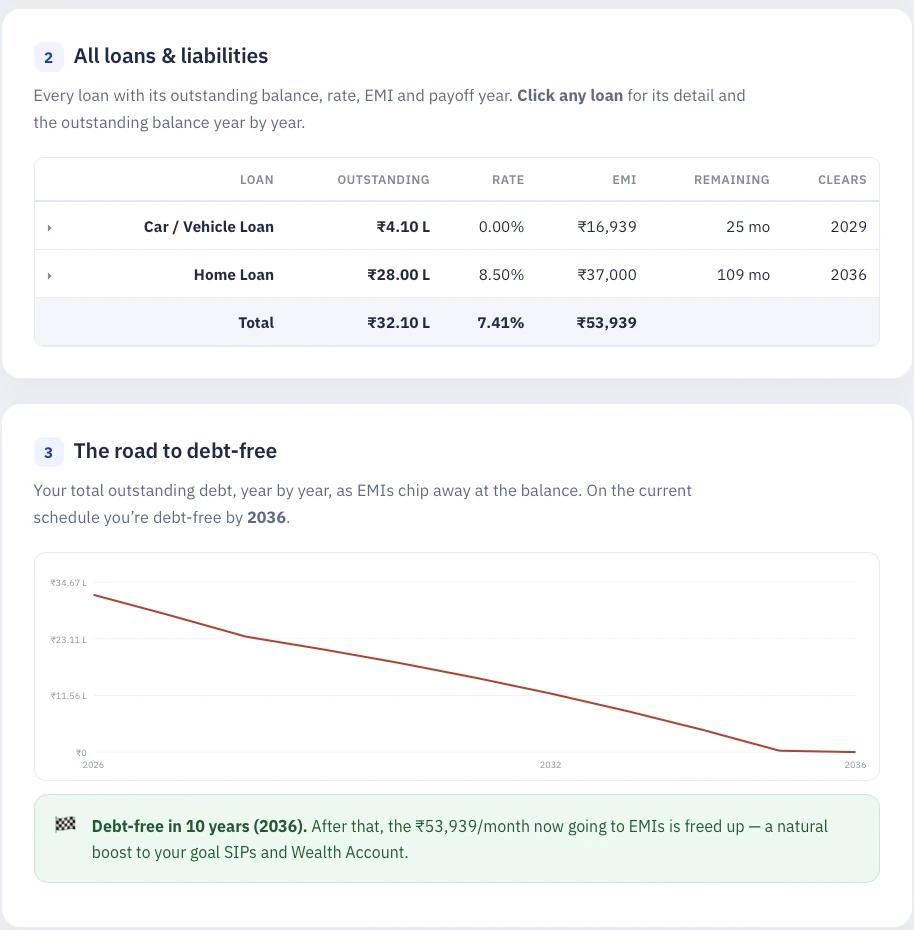
Your existing life and health cover and emergency reserve, considered against the level of cover your circumstances call for, so that any gaps are made visible.
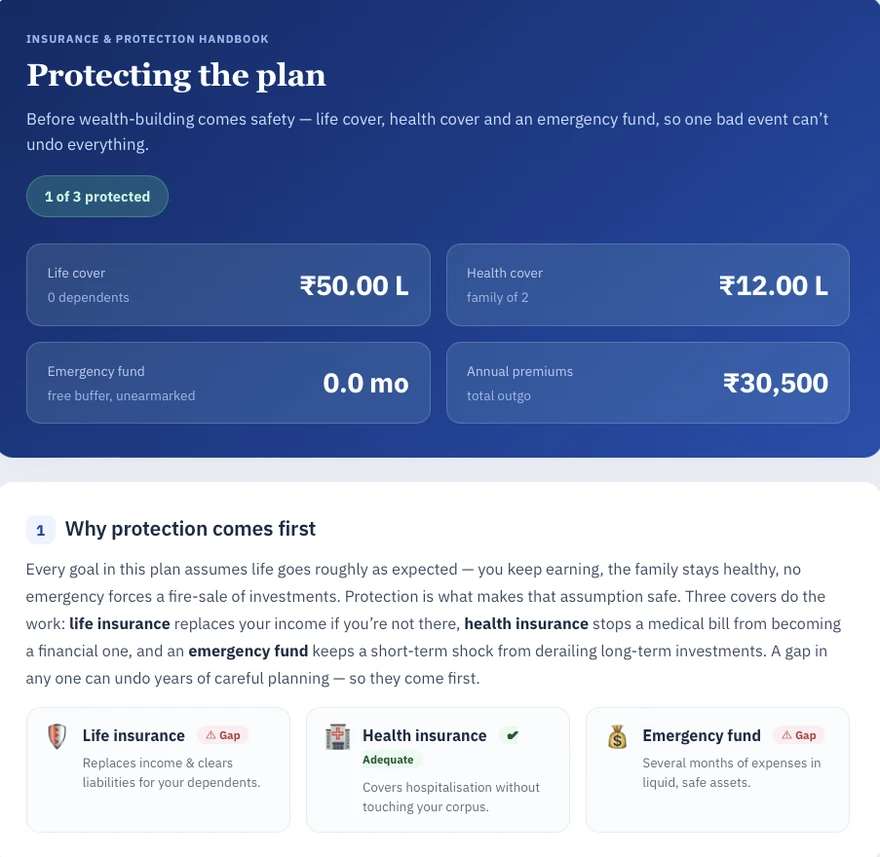
A structured summary of the strengths, gaps, opportunities and risks in your present position — the considerations that inform the recommendations that follow.
Your Financial Goals
Each goal you wish to plan for is recorded, quantified in today’s terms and in the year it falls due, and matched to the resources intended to fund it.
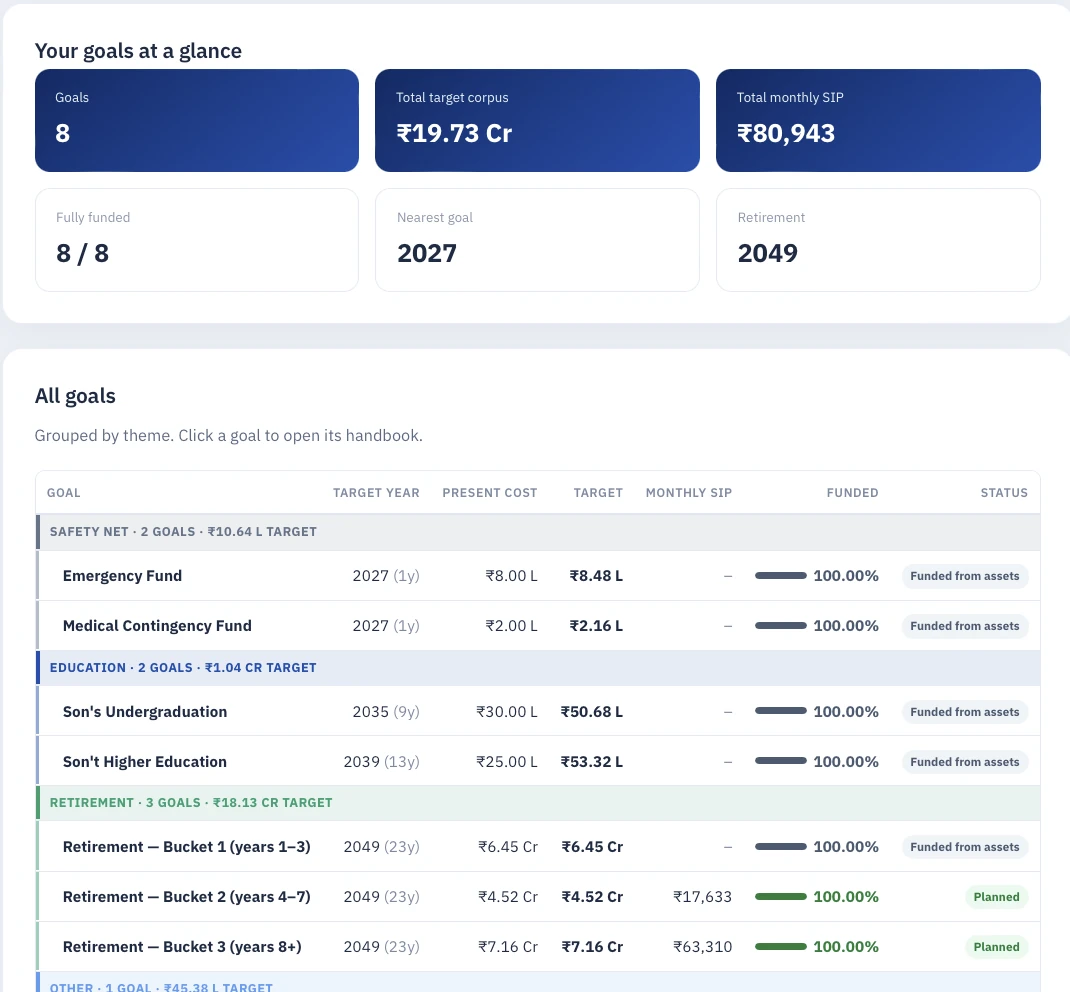
Every goal — education, a home, family commitments, retirement and others — with its present cost, the amount required in its target year, and its current funding status.
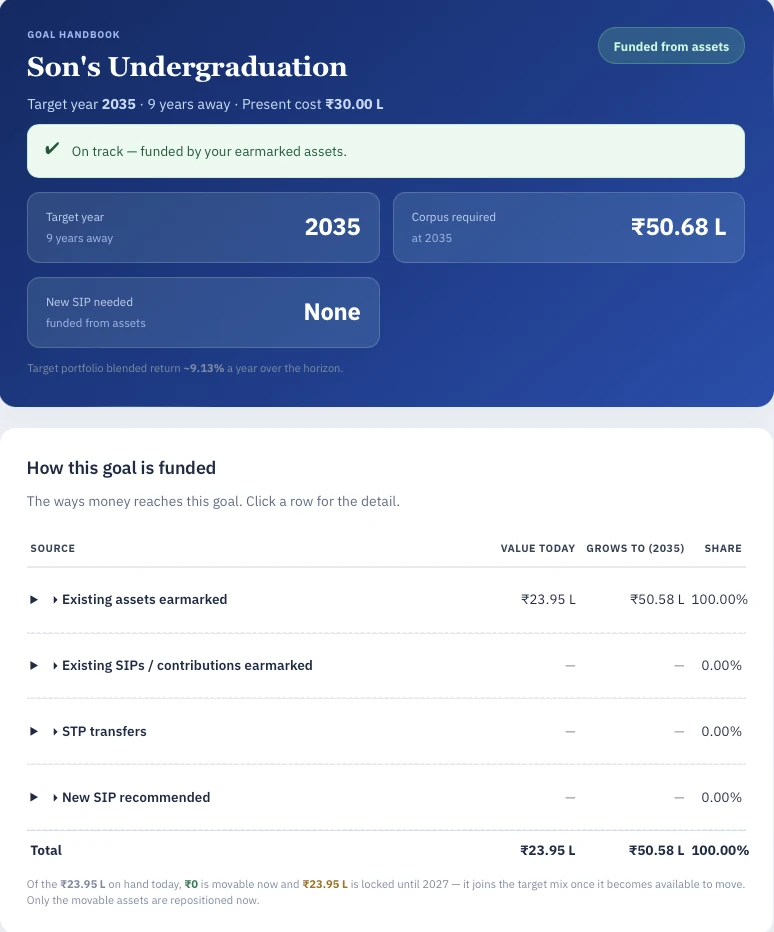
For any goal, the sources expected to meet it — existing assets, ongoing contributions and any new investment required — and how the projected corpus compares with the amount needed.
Your Financial Roadmap
The roadmap projects your finances year by year across your lifetime — income, expenses, savings, goal funding and net worth — so the plan can be read as a single, connected picture rather than a set of separate calculations.
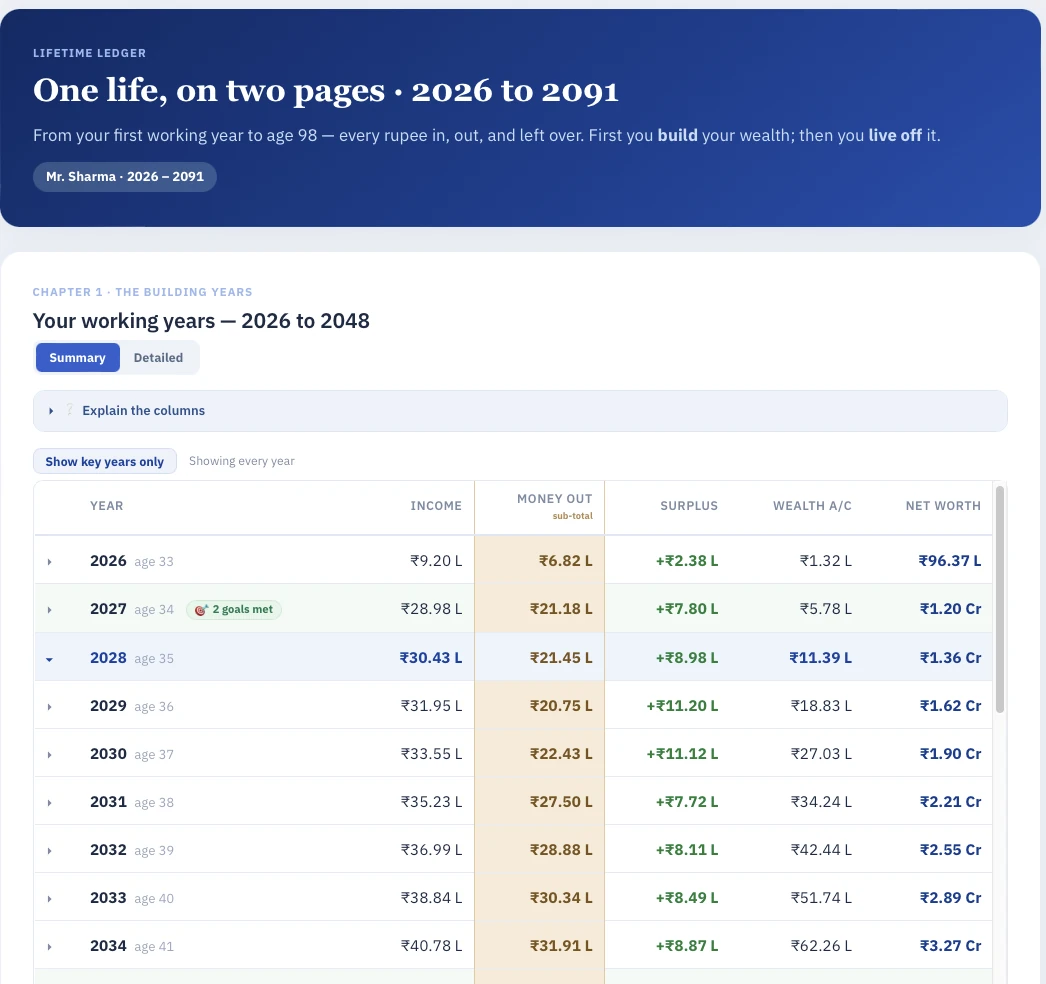
A year-by-year view from today through the length of the plan: what comes in, what goes out, what is saved and invested, and how your net worth is projected to develop over time.
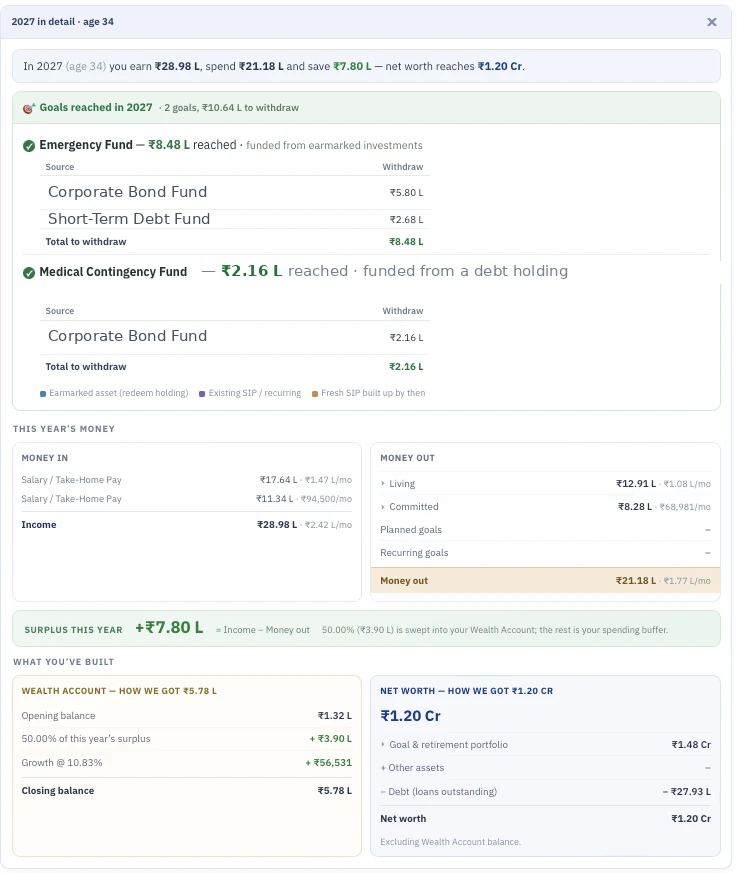
Each year can be examined on its own — the income received, every category of expense, the amount saved, and the resulting net worth for that year.
Investment & Goal-Funding Strategy
This section sets out how your money is to be invested and how each goal is to be funded — the asset allocation, the use of existing holdings, the recommended contributions, and the approach to rebalancing over time. It is where the plan explains what is to be done, and why.
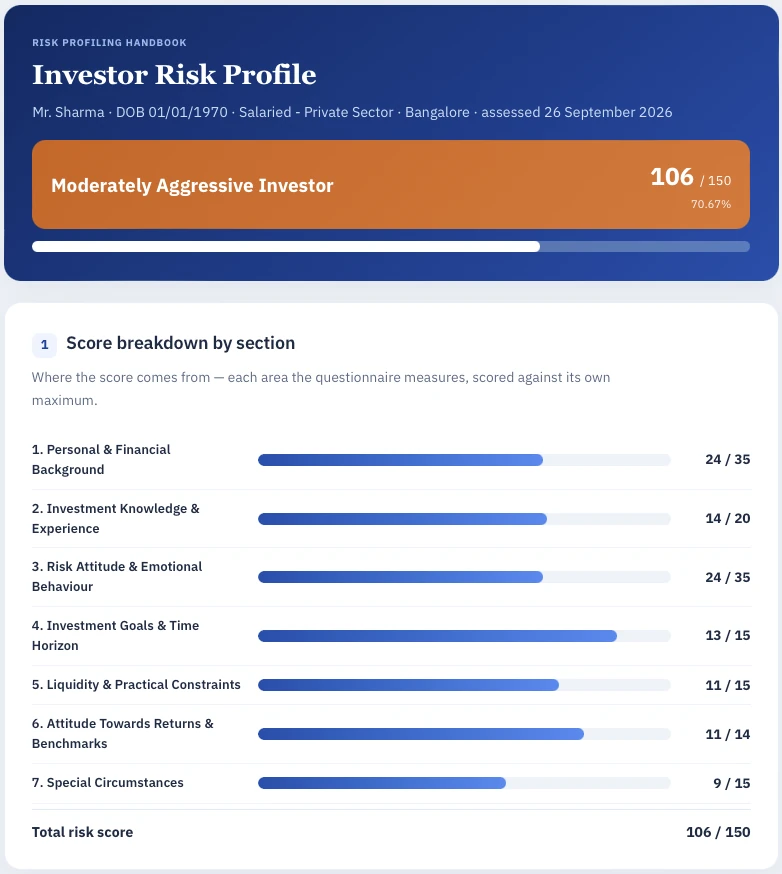
A structured questionnaire establishes how much investment risk suits you — both your capacity to take it and your temperament. The recommended asset allocation is then built to match this profile.
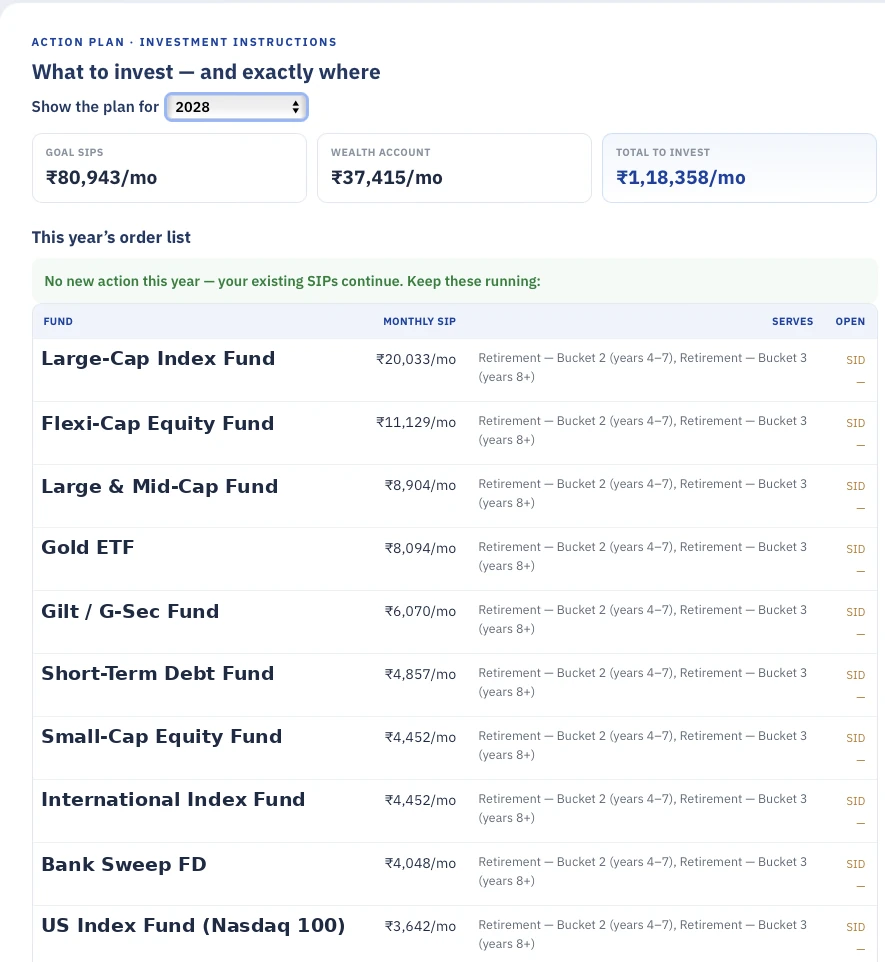
The monthly contributions recommended for the period ahead, by type of fund and the goals each supports. The specific funds are named in your own plan; here they are shown by category only.
The blended mix across every goal, year by year — open any year to see the consolidated buy-list beneath it. The specific funds are named in your own plan; here they are shown by category.

Retirement Planning
Retirement is planned in detail: the corpus required, the income and expenses expected, how the corpus is accumulated and later drawn upon, and how the picture holds over a long retirement.
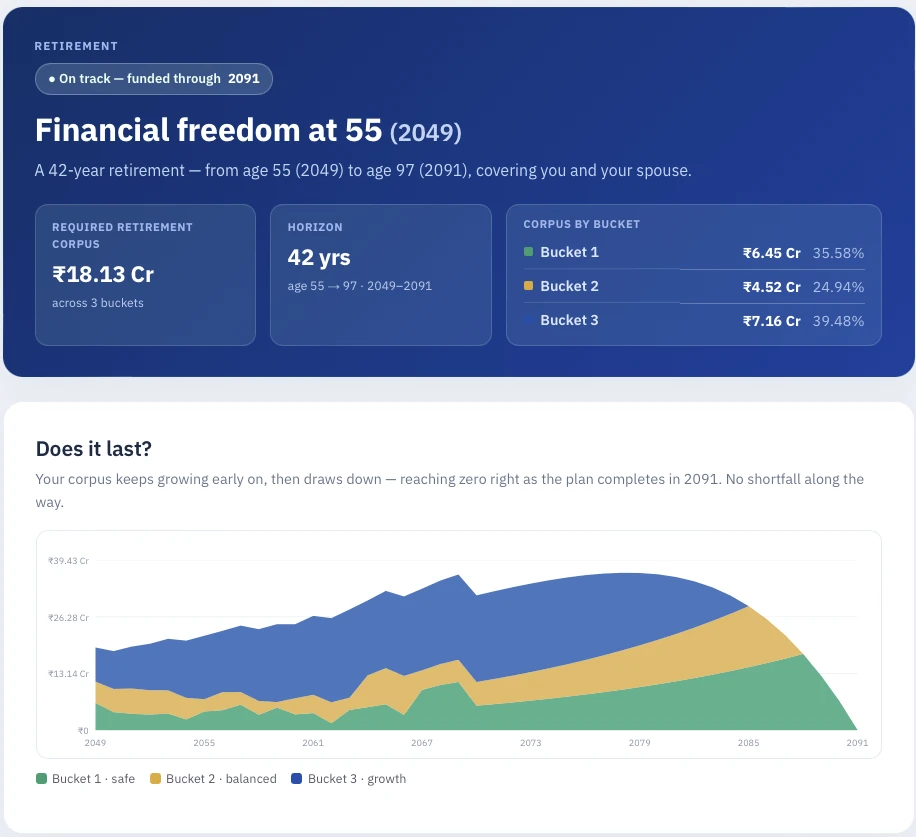
The corpus your retirement is projected to require, how it is apportioned for the near, medium and longer term, and how it is expected to be drawn down across the years of retirement.
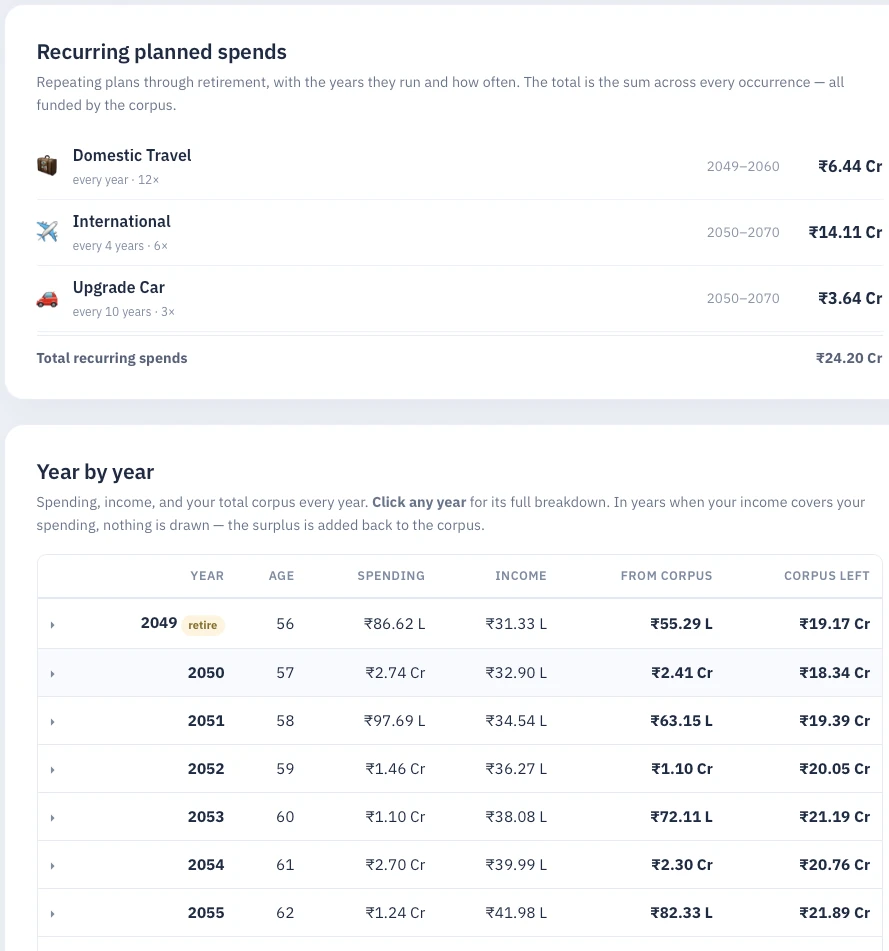
The repeating plans through retirement — travel and the like — with the years they run and how often, followed by a year-by-year view: the expenses to be met, the income still expected, and the amount drawn from the corpus, each year available in full detail.
How the corpus is organised and rebalanced through retirement, keeping money needed soon in steadier holdings while longer-dated money remains invested.
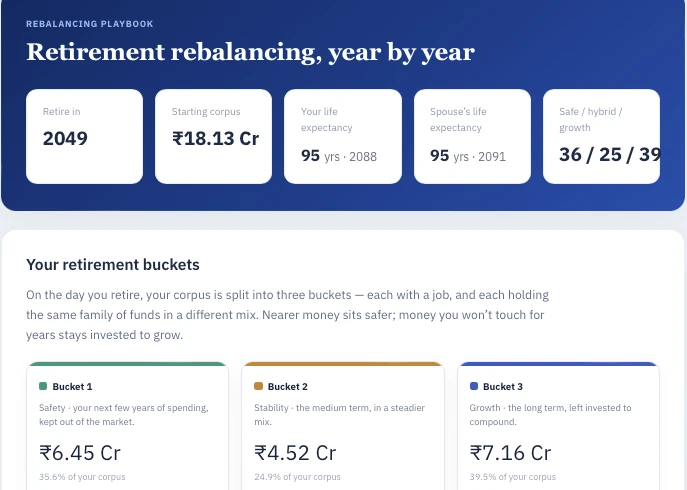
The income still expected once you retire, the three buckets the corpus is divided into by when the money is needed, and the one-off spends — such as a home renovation — each planned, timed and funded by the corpus.
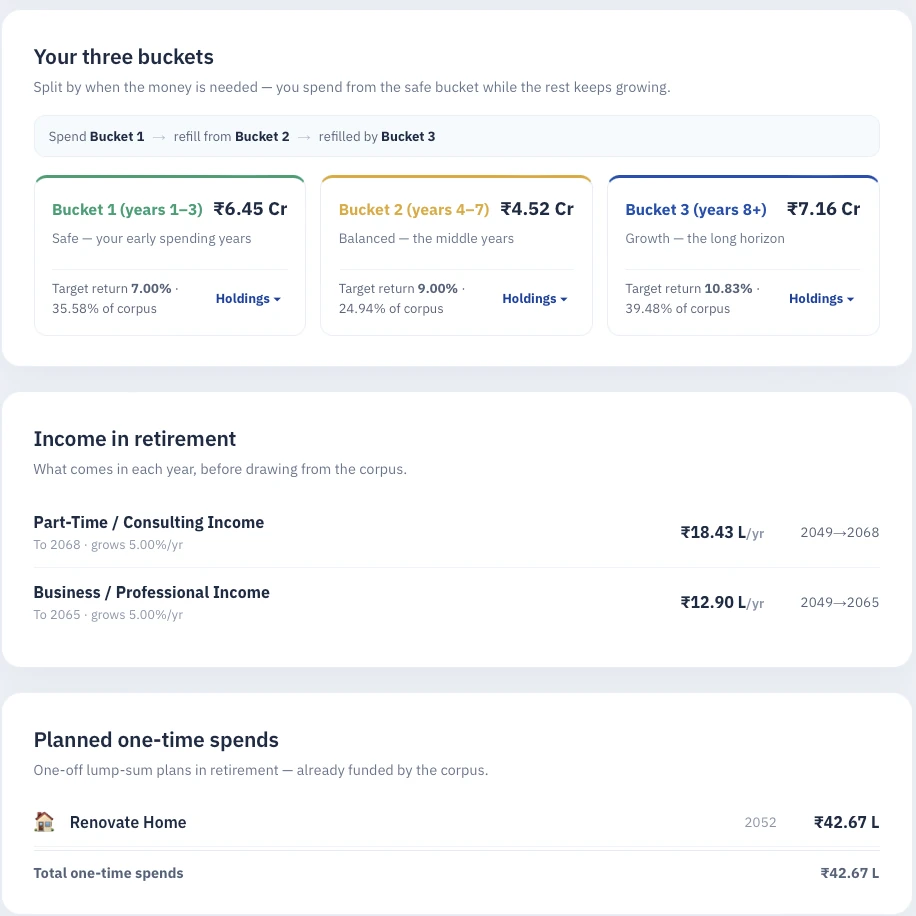
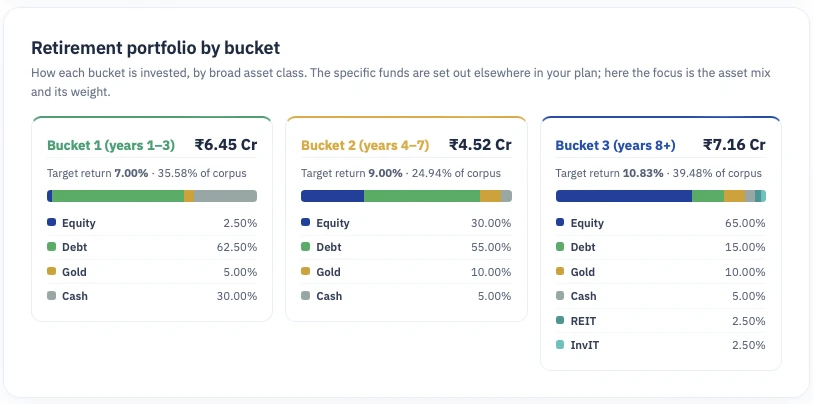
The corpus is held in three buckets by when the money is needed — Bucket 1 kept safe for the early years, Bucket 2 balanced for the middle years, and Bucket 3 growth-oriented for the long horizon — each shown by broad asset class and weight.
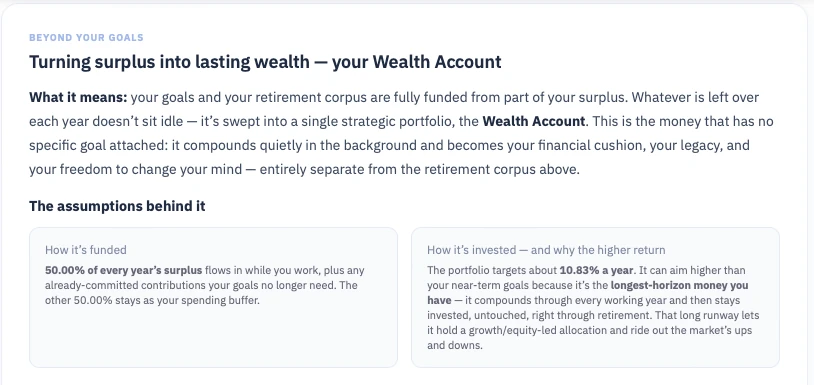
Beyond Your Goals — Your Wealth Account
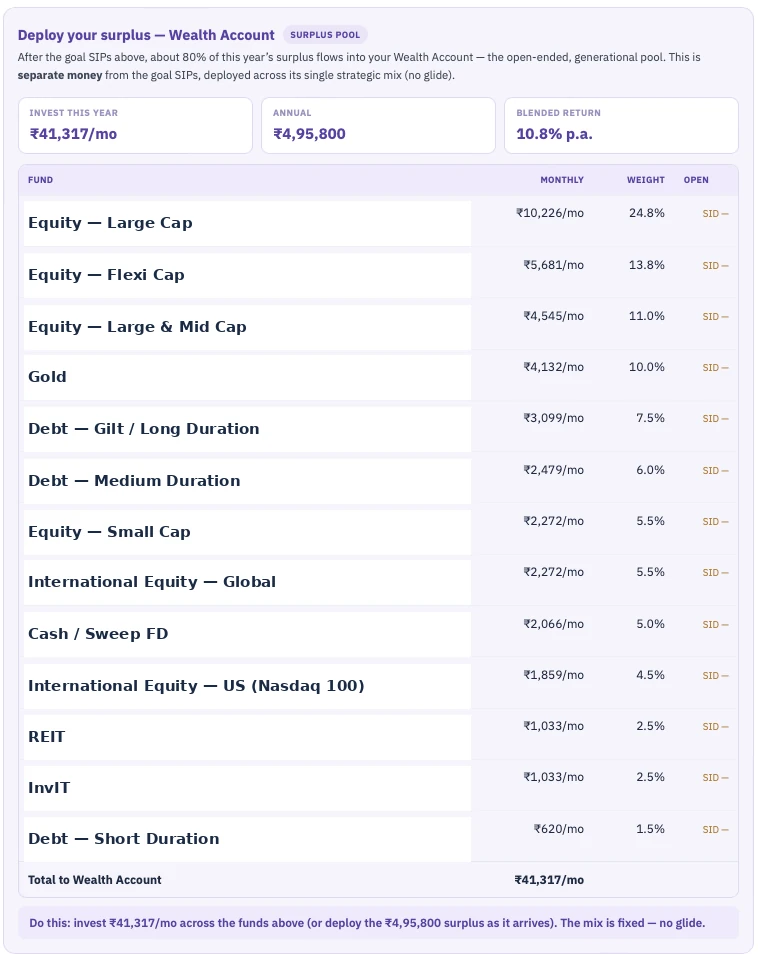
Once your goals and retirement are fully funded, the surplus each year is not left idle. It is directed into a single strategic portfolio — the Wealth Account — money with no specific goal attached, which compounds quietly to become your cushion, your legacy, and your freedom to change your mind.
How the Wealth Account works, and why it is kept separate from your goals and your retirement corpus — the part of your surplus set aside to build across your whole life.
Where each year’s surplus is invested, by asset class and weight, as a single strategic mix. The specific funds are named in your own plan; here they are shown by category.
Risk Management & What-If Analysis
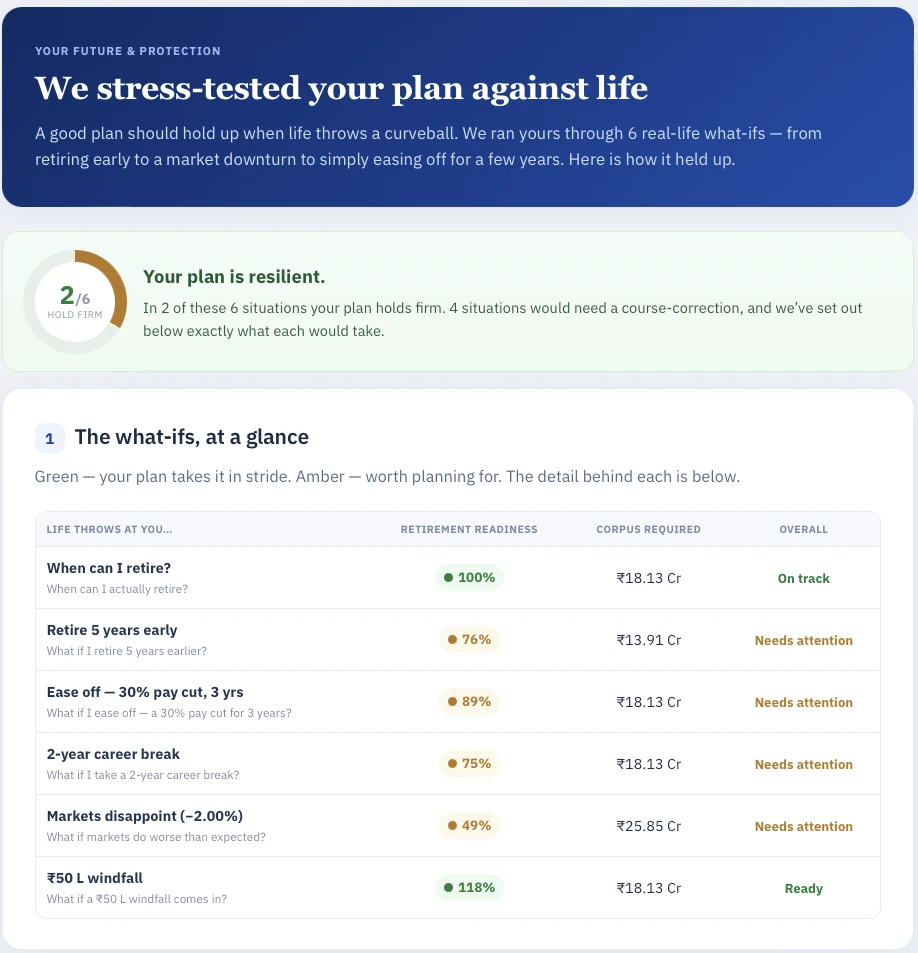
The plan is examined against circumstances that may not go as expected — retiring earlier, a market downturn, higher inflation, an interruption to income, an unplanned expense, or a longer life. For each, the plan shows what changes, so the position can be considered in advance.
A set of realistic circumstances examined against the plan — earlier retirement, weaker markets, higher inflation, a career break and others — each showing how the requirement and the funding position change.
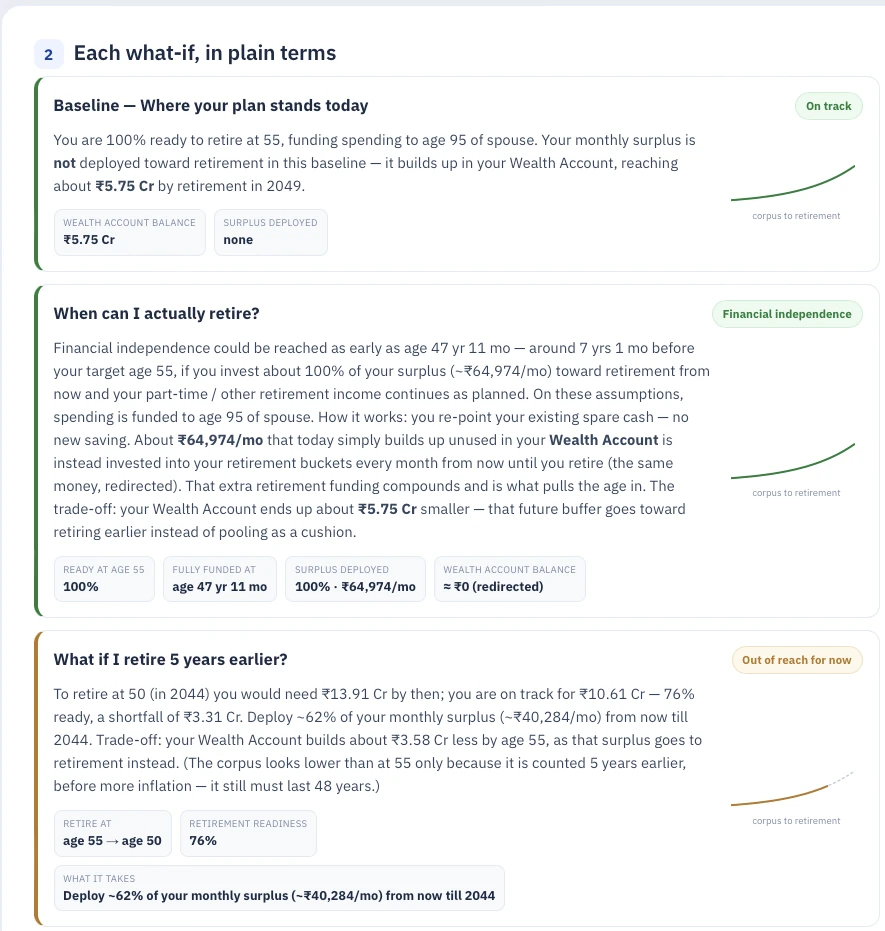
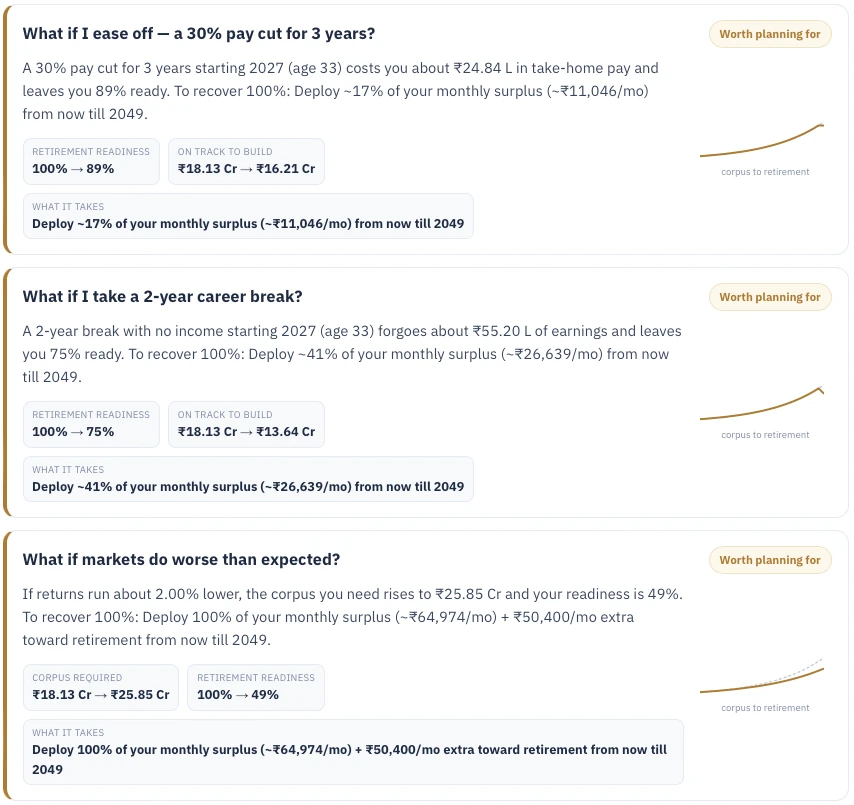
For every scenario, a plain explanation of what it would mean in practice: what it would take to accommodate, and how it affects the path to your goals.
The opposite question: once you have stopped earning and are drawing the corpus down, does it last — and how does it hold up if life does not go to plan?
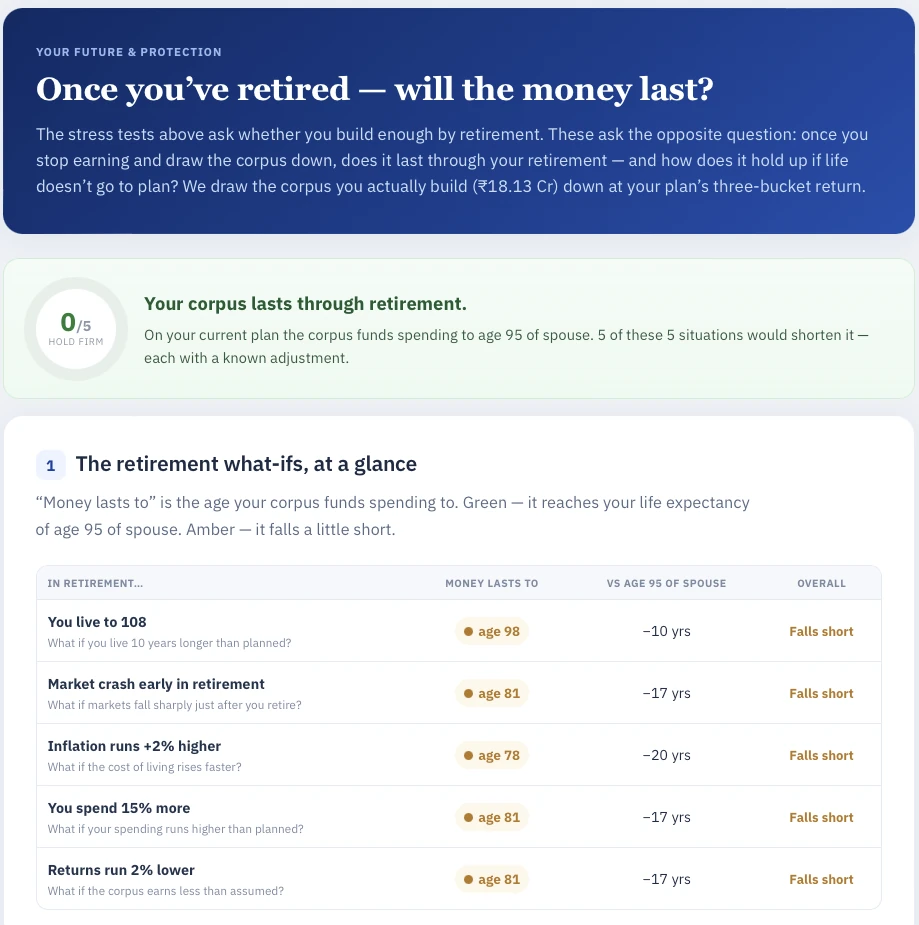
For every post-retirement scenario, a plain explanation of what changes and what it would take — spending a little less, or retiring with a larger corpus — to keep the money lasting to your planned age.
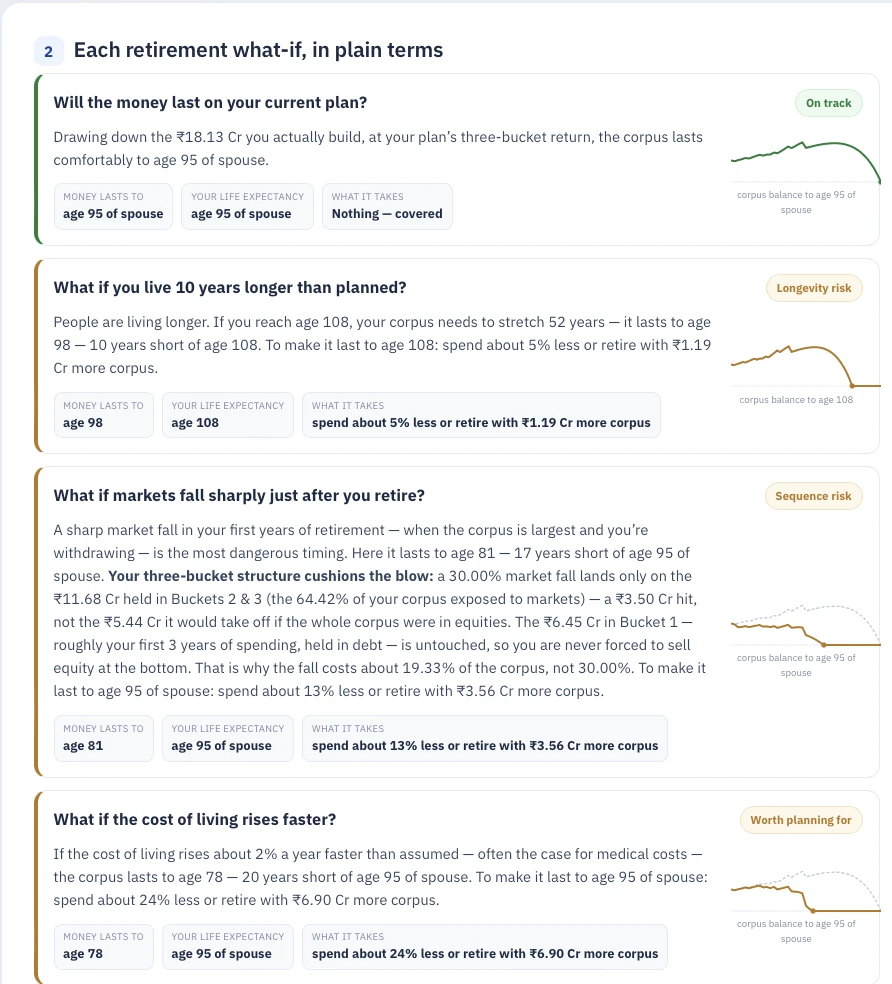
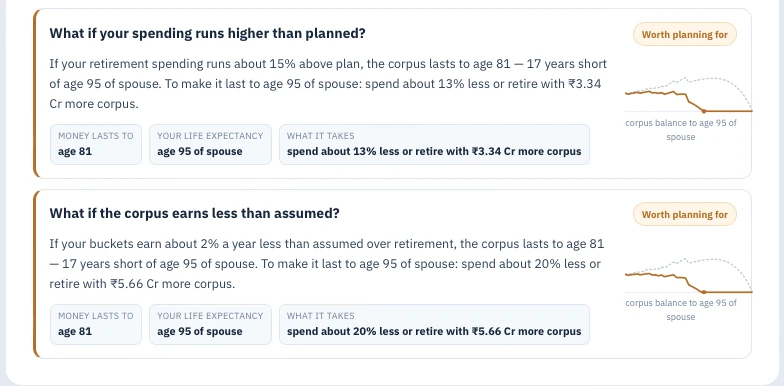
How the picture changes with retirement age
A simple illustration. Adjust the retirement age to see how the projected corpus, and the age to which it is expected to last, respond. In your own plan, scenarios such as this are examined together, using your figures.
Figures are illustrative and for explanation only; your own plan is prepared from your circumstances.
Implementation & Review
Finally, the plan sets out what to act on and in what order, provides the underlying figures in editable form, and explains how it is kept current as your circumstances change.
The complete figures are provided as editable Excel workbooks — every schedule and calculation — so each number can be examined, and an assumption changed to see the whole model recompute.
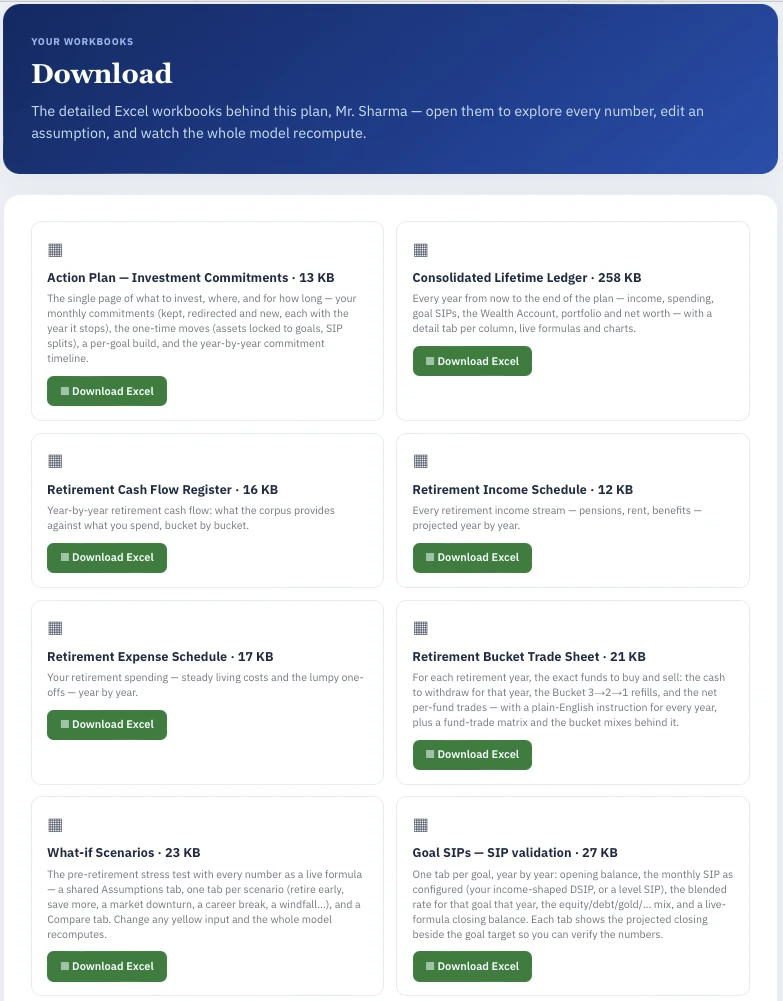
Putting the plan into effect, and keeping it current
The action items are listed in priority order, with a clear indication of what to set in place first. The plan is then reviewed with you and updated as your circumstances, and the markets, change over time.